 One of the most noticeable trends in the mobile world in recent years is the advent of ‘small cells’. Small cells (a term which encompasses femto-, pico- and microcells) have become increasingly popular in larger enterprises, shopping malls and airports, where there is demand for 2G, 3G and LTE mobile services inside large buildings.
The development of small cells has been driven to address the availability and quality of in-building coverage which is not adequately served by the macro cell, as well as deliver higher throughput in areas of high density traffic.
Small cell deployments for enterprises differ from their residential cousins in the larger number of users and coverage area catered for, the potential for RF interactions between cells, mobility and handover issues from one cell to another, and the large RF variations that can be experienced inside buildings. These factors make installation somewhat more complex than a typical residential version.
Just as basestation size is effectively decreasing, so the test equipment used to optimise installation has reduced in size. Walk test equipment is being adopted by mobile operators to optimise small cell installations and ensure that high-value enterprise customers get the mobile experience they pay for.
Small versus large cell test
From a test point of view, the functional test requirements of a small cell deployment are very similar to their larger cousins. However, the test equipment required needs to be much lighter, smaller and more discrete, as it is typically carried in a backpack.
Walk test devices, as they are often referred to, are used to conduct ‘walk tests’ with one or more mobile phones to check coverage levels. Used primarily by IT technicians – as opposed to trained RF engineers – these devices allow users to compare network performance as seen from multiple devices, and ideally need to be very easy to use and feature real-time control and analysis capabilities.
In reality, they need to be almost as fully-featured as the test equipment used for the average basestation (or macrocell).
Different small cell vendors and mobile operators have different deployment requirements.
According to Syed Hashmi, RF engineer at ip.access, a company dedicated to small cell development: “To optimise a small cell’s effectiveness, our engineers typically recommend running a standard set of 50 to 60 tests at each new deployment site.”
Typical test scenarios are designed to reflect mobile operator’s key performance indicators (KPIs) i.e. mobility, accessibility and retainability with the goal of ensuring quick and seamless transfer of voice and data services. ip.access’ tests include voice calls, data tests (FTP DL/UL, HTTP BROWSER), messaging (SMS & MMS), multi data, multi-mix, multi-RAB (whereby data and call tests are executed sequentially or in parallel), idle mode monitoring, serving cell and neighbour cell information, as well as related RF parameters in order to monitor reselection and handovers.
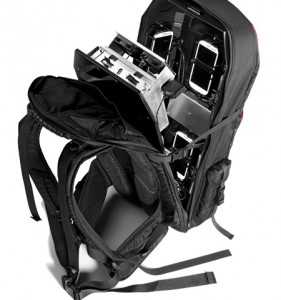
Freerider II
A small cell test solution
IP.access’ Professional Services division provides training for mobile operator staff on how to achieve ‘right first time’ deployment of its small cell solutions.
With mobile operator service contracts across the Americas, Europe, Middle East and Asia, ip.access needed a replicable, portable, cost-effective test solution that would quickly and efficiently provide answers to typical networking problems. These include the ability to see a cell, check whether you are getting the required throughput and whether there is sufficient coverage, where the blackspots are and whether there is any interference between cells.
From January 2014, ip.access has used the QualiPoc Freerider II test system from Rohde & Schwarz to collect data and voice service statistics for 2G and 3G monitoring, inside and outside buildings.
The system, which is made by Rohde & Schwarz’ Swiss subsidiary SwissQual, allows users to run different tests on up to six of the latest smartphones in parallel, enabling the small cell vendor to ‘real-life’ test all major wireless networks and technologies, including GSM, GPRS, EDGE, WCDMA, HSDPA, HSPA+, HSUPA and LTE, VoLTE and Wi-Fi.
IP.access uses a four handset system that can be used to test multiple networks simultaneously, or work in parallel to simulate multiple users and stress test the capacity of the small cell.
The handsets within the system can also be used stand-alone so that up to four engineers can work independently using the hardware contained within a single FreeRider 2 system. The test solution provides real-time control and analysis on the tablet but for more complex troubleshooting tasks, results can be saved and analysed offline using R&S ROMES post-processing software.
A specific test requirement from ip.access was the need to lock on to a specific 3G scrambling code. With this feature enabled on the Freerider 2 handset, the user can lock the cell to a particular small cell in what’s known as ‘cell forcing’.
Cell forcing comes into play when a small cell is not yet optimised. Preventing the phone from roaming onto the macrocell improves test speed and reliability. It also means that the user can walk away and check coverage area of a specific cell by looking at when the phone loses connection to the cell in question.
“Freerider has come in handy in many deployment scenarios, be it initial deployment or live network,” said Hashmi.
“It measures quality metrics on application layer, IP layer, layer 3 and also air-interface level at any desired location, and GSM, WCDMA and LTE network measurements can all be easily performed using this equipment.”
Whilst test manufacturers have largely won the battle of creating smaller testing devices that match the trend to reduce base station size, the challenge of keeping up with the mobile industry’s pace of development is ongoing.
With LTE networks being rolled out, the next step for testing is VoLTE, Voice over LTE. QualiPoc software has for some time supported tailored pre-commercial devices to test VoLTE interoperability with legacy network technologies, although as yet, commercial devices are not available.
Steven West is an account manager at Rohde & Schwarz UK
Nhận xét
Đăng nhận xét