The next generation 5G mobile phone technologies will be the first to make extensive use of modular test and design platforms for its development.
The scale of the signal processing required for the multi-gigabit radio channels expected to be needed for 5G, will need highly scalable systems for development and simulation.

With technical specifications not expected to be finalised for another year or so, there is also a need for configurable systems.
As a result a modular platform such as PXI is being adopted in the early design for 5G systems both in the UK and Germany.
LabView is used to map design algorithms directly onto the FPGA. The advantage of LabView is that is gives a high-level representation of the compiler and low-level FPGA design.
5G starts with the creation of 4G standards, so the development software must retain compliance with previous standards.
Lessons have been learnt from the development of 4G mobile standard, particularly in the definition of a 20MHz channel width and the need for data capacity.
“Five years after the definition of 4G we know that we do not have enough bandwidth,” says Jeff Phillips, senior LabView product manager at National Instruments.
The early stage functional design must also include the validation of the various options for the width of the radio channel and the modulation and demodulation schemes.
Design teams are looking for configurable hardware and software to maintain flexibility in their developments.
For this reason modular development platforms with FPGA prototyping and software defined radio (SDR) are being used in the early stage 5G development work in the universities of Surrey and Bristol as well as at Technische Universität (TU) Dresden in German.
“With our collaboration and the use of the NI platform, TU Dresden researchers significantly compressed the time to transition from concept to prototype,” says Gerhard Fettweis, Vodafone chair at Technische Universität Dresden.
The LabView Communications system design suite can be used with a software defined radio (SDR) module to prototype 5G systems. This environment enables the design team to map an idea from algorithm to FPGA using a single high-level representation.
It can remove the necessity manually mapping algorithms to different hardware architectures.
“In six weeks, we were able to have a working prototype. In the past, using other standard tools, this process would have taken us more than two years to complete,” says Fettweis.
LabView Communications includes frameworks for Wi-Fi and LTE which can be a basis for the 5G design. “For some of the academic and industry researchers in our lead user program, this approach has cut the time to a validated prototype in half,” says James Kimery, director of RF and Communications at NI.
Modular test systems are also expected to play a big part in the development and roll-out of 5G systems over the next five years.
“No one knows what 5G will be exactly so we believe it will require a flexible test approach such as modular platform like PXIe,” says Phillips.
 Development of 5G is currently focused on two radio architectures – wide channel milliwave (mmWave) radio transmission and multiple in, multiple out (MIMO) radio transceivers on an unprecedented scale.
A PXIe-based development system is being used in Dresden to simulate a massive MIMO basestation with 100 radio transceivers working together.
“This is a very complex and costly process, so the use of software defined radio reduces the cost per channel and LabView software provides the scalability, which accelerates the development path,” says Phillips.
The challenge with mmWave radio transmission in the 60GHz frequency band is the large bandwidth of the radio channel.
Development is looking at 1GHz or even 2GHz channels to meet the expected data capacity demands of mobile networks in 2020 and beyond.
At 4G a single radio channel is fixed at just 20MHz, which has needed to be aggregated up to 100MHz with carrier aggregation.
The challenge with the large 1GHz radio channels is the scale of the real-time data processing required to modulate and demodulate the data channel for radio transmission.
Instead of writing a framestructure for the data stream from scratch, much of the development work is making use of existing LTE framestructure.
However, 5G will use a new waveform structure for the radio channel. Work in the Dresden-based 5G lab is focusing on generalised frequency division multiplexing (GFDM) instead of the orthogonal frequency division multiplexing (OFDM) used for 4G.
GFDM is expected to have more spectral efficiency due to its support of multi-carrier schemes using block-based data transmission with efficient FFT-based equalisation. GFDM enables frequency and time domain multi-user scheduling comparable to OFDM and provides an efficient alternative for white space aggregation even in heavily fragmented spectrum regions.
“What better way to experiment on 5G than to start with 4G,” says Phillips.
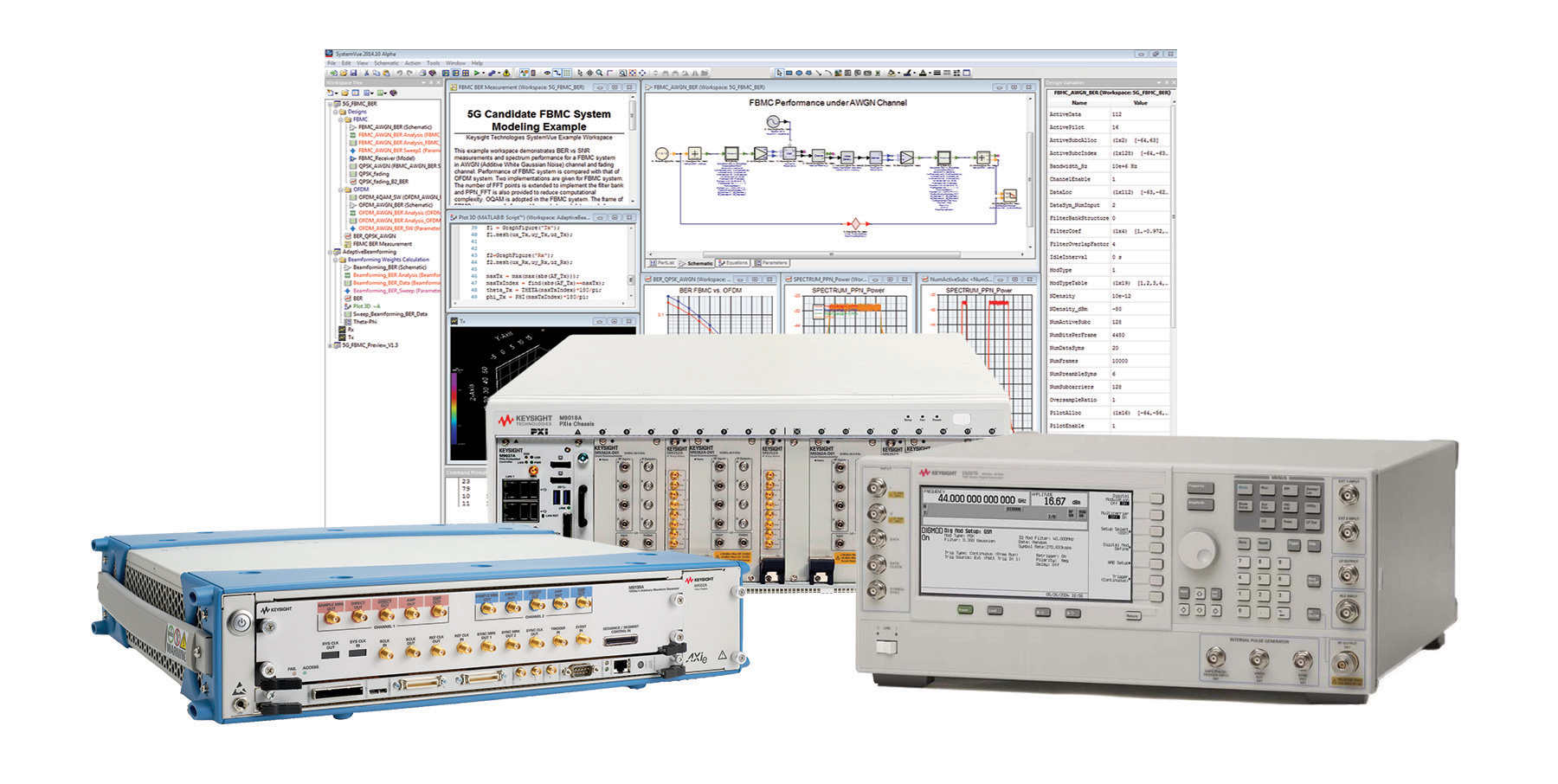
Keysight Technologies has demonstrated an mmWave channel-sounding measurement set-up.
Channel sounding for the mmWave frequency band is an important aspect of the 5G radio channel design.
Designers use Keysight’s SystemVue system level design and simulation software to model the 5G air-interface.
The early stage of 5G research requires the creation of custom waveforms for 5G applications.
Keysight Technologies’ N7608B Signal Studio can be used for creating 5G candidate waveforms, such as filter bank multicarrier (FBMC), as well as custom OFDM and I/Q configurations.
When testing the hardware design, the software will be used in tandem with Keysight’s signal generators and arbitrary waveform generators.
In Germany, Rohde & Schwarz has created an mmWave test set-up for the Fraunhofer Heinrich Hertz Institute (HHI).
While signal propagation in the 450MHz to 3GHz frequency bands used for 3G and 4G are well characterised, this is not the case for the radio spectrum above 6GHz, which will be used for 5G.
“Microwave frequencies will mean a disruptive change for mobile communications,” says Alexander Pabst, vice president systems and projects at Rohde & Schwarz.
According to Rohde & Schwarz, new spectrum in the discussed range from 6GHz to 100GHz requires much more measurement data.
“Multiple research projects as well as the upcoming 3GPP standardization need comprehensive measurement data in order to derive suitable channel models for efficient testing in future,” said the test firm.
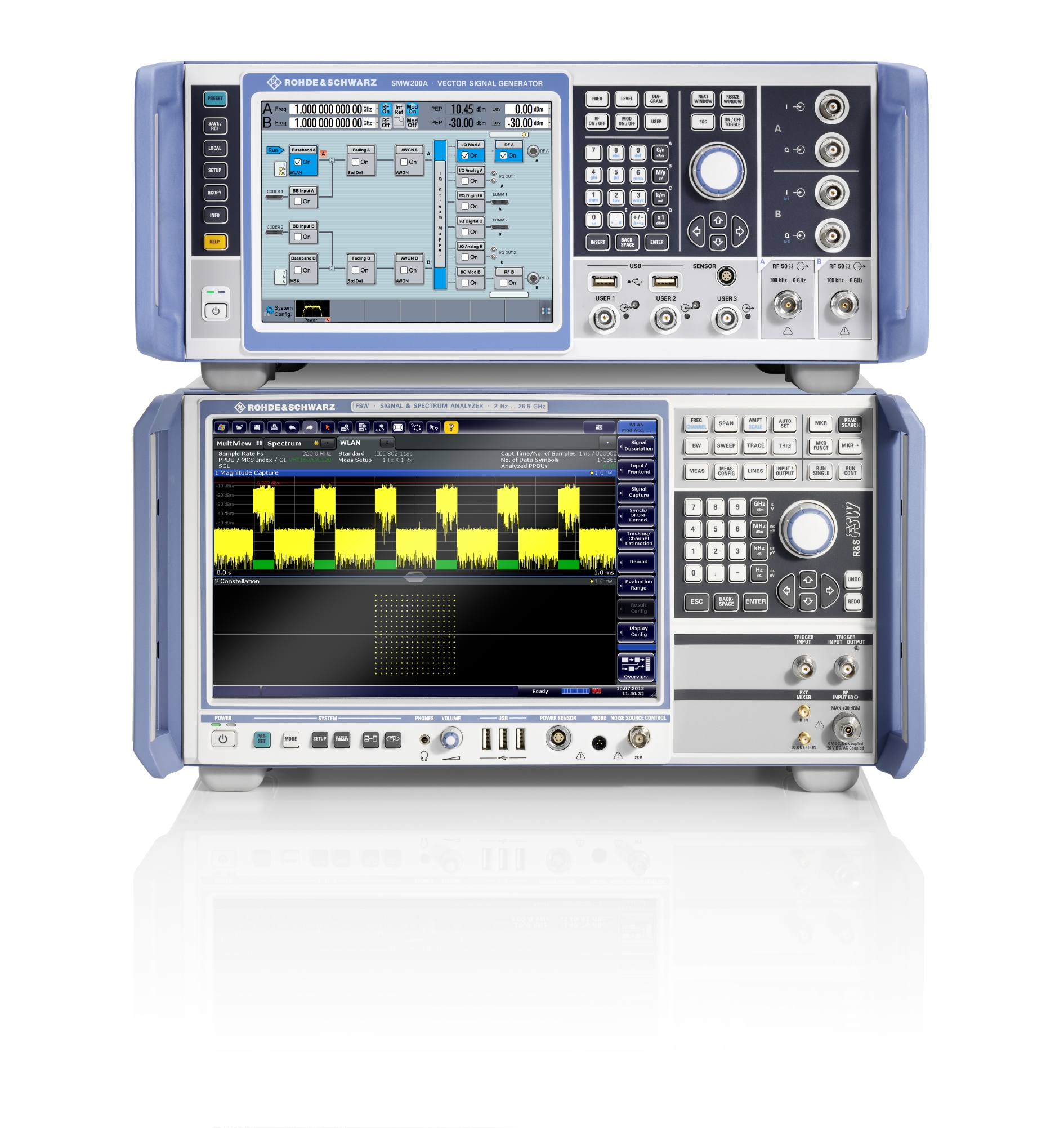 The test set-up comprises the SMW200A vector signal generator and the AFQ100B I/Q baseband generator on the transmitter end and the FSW signal analyser on the receiver end. The transmitter and receiver are synchronised and triggered by high-precision clocking units from Fraunhofer HHI.
This provides a wideband sounding signal with up to 500MHz signal bandwidth and up to a carrier frequency of 67GHz. After the signal is demodulated software from Fraunhofer HHI estimates channel impulse responses in the time and delay domains. The same measurement concept could be extended for measurements above 40/67GHz by adding external up/downconverters on both ends.
“A 2GHz demodulation bandwidth could also be realised using a wideband I/Q baseband generator from Fraunhofer HHI on the transmitter end. This uses the newly released FSW-B2000 2GHz analysis bandwidth option for the Rohde & Schwarz FSW analyser at the receiver.
According to Thomas Haustein, head of the wireless communications at Fraunhofer HHI: “This contributes to a better understanding of radio propagation, making it possible to derive realistic channel models for the relevant wireless use cases.”
The challenges of 5G mobile will make it inevitable that software configurable hardware and modular systems will play a crucial role in the development of the next mobile phone standard.
Nhận xét
Đăng nhận xét